Severe Acute Respiratory Syndrome outbreak
The Wisdom of CrowdsThe SARS outbreak emerged in late 2002 and became a global health emergency in early 2003. Its cause was identified through a World Health Organization-coordinated network of eleven laboratories, whose shared evidence and parallel investigations made a discovery no single laboratory could claim alone.
Emergence and Global Response
In early February 2003, China’s Ministry of Health informed the World Health Organization that, since November, 305 people in Guangdong Province had contracted a severe respiratory disease and five had died. The symptoms resembled influenza, but laboratory tests had ruled out influenza viruses. Within weeks, a man returning from China and Hong Kong fell ill in Hanoi, while workers at a Hong Kong hospital developed similar symptoms. Reports of additional outbreaks followed. By early March, it was apparent that the illness, named SARS, was a new disease rather than a new form of flu.
The World Health Organization issued a global warning, advised travelers to be cautious about journeys to southern Asia, and activated a surveillance system to alert it to further outbreaks. Because SARS was known to spread from person to person, tracking its spread could help guide quarantine measures. But identifying the cause was also urgent: it could make testing possible and might eventually support development of a vaccine.
The International Laboratory Effort
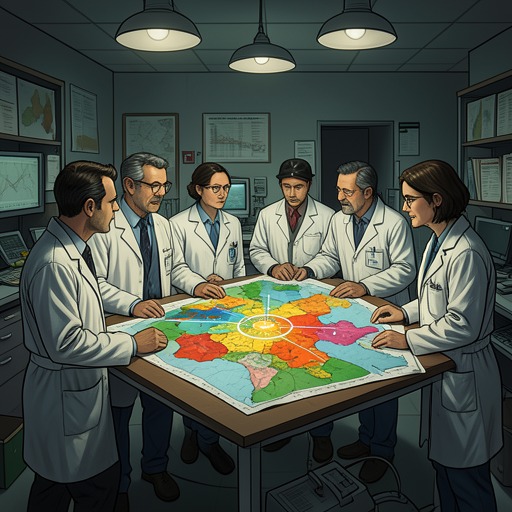
On March 15 and 16, the World Health Organization contacted eleven laboratories across countries and regions including France, Germany, the Netherlands, Japan, the United States, Hong Kong, Singapore, Canada, the United Kingdom, and China. All agreed to participate. Beginning March 17, the laboratories conducted what the organization called a collaborative multicenter research project.
The network made evidence available across institutional borders. Researchers held daily teleconferences to share work, consider new investigative approaches, and debate results. They posted electron-microscope images of viruses isolated from SARS patients, analyses, and test results to a World Health Organization website, and regularly exchanged virus samples so that laboratories could check and build on one another’s findings. Working simultaneously on the same samples allowed them to move faster than a sequence of isolated investigations would have.
The collaboration first narrowed the field. In the opening days, researchers considered and discarded multiple possible causes, including viruses found in some patients’ samples but not others. On March 21, scientists at Hong Kong University isolated a virus that appeared promising. That same day, scientists at the U.S. Centers for Disease Control independently isolated a virus that looked under an electron microscope like a coronavirus. This was unexpected: coronaviruses were known to cause serious illness in animals, while their effects in humans were generally mild.
Evidence accumulated across the network. Over the following week, laboratories detected the coronavirus in samples from a wide range of people diagnosed with SARS. Researchers in Germany, the Netherlands, and Hong Kong began sequencing it. In early April, infected monkeys in a Netherlands laboratory developed full-blown SARS. By April 16, just a month after the project began, the laboratories were confident enough to announce that the coronavirus caused the disease.
A Collective Discovery
Cynthia Goldsmith, an electron microscopist at the Centers for Disease Control and Prevention laboratory in Atlanta, was the first person known to have spotted the coronavirus. But that observation alone did not establish that it caused SARS. The claim depended on weeks of work across laboratories, including repeated detection of the virus in patients and the elimination of alternative candidates. Even the negative results mattered because they reduced the range of possible explanations.
For that reason, the discovery cannot be assigned to Goldsmith or to any one laboratory. The World Health Organization’s account described the laboratories as having collectively discovered the coronavirus. An individual laboratory working alone might have needed months or years to isolate it; the coordinated network reached the conclusion in weeks.
Coordination Without a Commanding Center
The World Health Organization organized the laboratory network, but no central authority directed each laboratory’s assignments, controlled which samples it studied, or prescribed how information should circulate. The participants agreed to share relevant data and speak every morning; beyond those commitments, they worked out how to divide the task themselves. The organization had no real power to compel academic or government laboratories to participate, so coordination depended on their agreement and continued cooperation.
That arrangement shaped the significance of the outbreak’s scientific response. The laboratories did not merely contribute separate observations to a later decision-maker: simultaneous testing, shared samples, and open debate allowed each group’s work to inform and accelerate the others. The account presents SARS as a case in which the cause became knowable through a distributed scientific effort, rather than through a single decisive expert or a hierarchy that controlled the investigation.